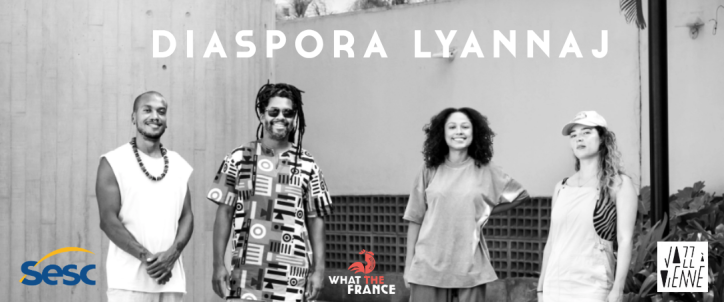
Diaspora Lyannaj : an exchange between French and Brazilian Jazz artists
Diaspora Lyannaj: When France and Brazil Compose a Common Language Born from an artistic residency between France and Brazil, the group Diaspora Lyannaj embodies far more than a simple musical collaboration: it is a human, cultural, and sonic encounter, supported by SESC São Paulo, the Centre national de la musique, and Jazz à Vienne.
Through two videos, this journey unfolds as a living process in which the differences between Fabio Leandro, Vanessa Ferreira, Boris Reine Adelaide, and Ysaura Mino become a creative strength. From the very first rehearsals, one thing becomes clear: the musicians do not all share the same language. Some speak Portuguese, others French. Yet music quickly establishes itself as common ground. The metronome becomes a universal reference point, and individual identities soon give way to a collective sound.
The project also highlights an interesting gap: the European perception of Brazil versus its current reality. Diaspora Lyannaj brings forward a key idea: there is not just one Brazilian music, but a multitude of traditions shaped by regions and cultures. Behind terms like Bossa Nova or Samba—often perceived as uniform in Europe—lies a much richer and more diverse reality. This confrontation of imaginaries acts as a reset, encouraging everyone to question their references and embrace a more contemporary vision.
Creating together required one essential condition: setting ego aside. The goal was not individual brilliance, but to offer a sincere work oriented toward the audience. This shared commitment allowed an authentic music to emerge, where each contribution finds its place without overshadowing the others. The project then takes a clear direction: avoiding clichés to explore a living, contemporary Brazilian music. Refusing to reproduce expected forms becomes a way to open a freer and more genuine creative space.
The meeting of French, Brazilian, and Caribbean musicians also reveals deep connections, particularly through shared rhythms and African heritage. The creative process unfolded very naturally: play first, talk later. Improvisation made it possible to quickly build a common language beyond spoken words. A striking difference appears in the approach to composition: in Brazil, everything starts with rhythm, whereas in France, it often begins with melody.
This complementarity becomes a strength, giving rise to music that is both rhythmically grounded and melodically rich. Finally, the residency provided a rare space to experiment, create, and take time. More than a musical project, Diaspora Lyannaj highlights the importance of openness to others—an essential condition for creating something sincere and collective.
See also
 Claude Debussy – Prélude à l’après-midi d’un faune | Once upon a masterpiece
What if a simple flute melody could change the course of music history? Composed in 1894, Prélude à l’après-midi d’un faune by Claude Debussy i...
Video
Claude Debussy – Prélude à l’après-midi d’un faune | Once upon a masterpiece
What if a simple flute melody could change the course of music history? Composed in 1894, Prélude à l’après-midi d’un faune by Claude Debussy i...
Video
 White Corbeau I LIVE SHOT
In this new episode of our Live Shot series, meet White Corbeau. What the France caught up with him during his performance at the BISE Festival. A Bel...
White Corbeau I LIVE SHOT
In this new episode of our Live Shot series, meet White Corbeau. What the France caught up with him during his performance at the BISE Festival. A Bel...